


VB-MAPP - Materials Checklist (Part 1 of 8)
Part 1 of 8 in our VB-MAPP series, which covers each piece of the assessment in depth. For a broad overview, see our one-page guide to the VB-MAPP.
Before you can administer the VB-MAPP, you need the protocol, the guide, and a surprising amount of ordinary early-learner material. Gathering it is one of the most time-consuming parts of giving this assessment, so this page is the checklist we work from, broken down level by level.
Before you start
The protocol and the guide are sold as a set. Spend time with both before you gather anything else, since the guide carries the scoring criteria and will tell you what each milestone actually asks for. Everything below is what you need on hand once you are ready to work with a child.
For all levels
- Some way of keeping time (e.g., watch or cell phone) for timed responses
- A copy of the protocol and scrap paper for taking notes if needed
- Preferred items that can be used as reinforcers for the child (e.g., snacks, toys, activities)
- Access to similar age peers, for assessing social skills
Level 1 (0 to 18 months old)
- 10 preferred items that could serve as reinforcers (e.g., chips, M&Ms, toys)
- 10 pictures of everyday things, people, or animals that are familiar to the child (e.g., toys, family members, and pets)
- 10 everyday objects that are familiar to the child (e.g., utensils, toys, snacks). Must include:
- Blocks or a Ring Stacker for assessing stacking.
- Small objects for assessing pincer grasp
- 2-3 inset puzzles that involve identical matching (must have 10 pieces total between all puzzles) or 10 pairs of identical items (e.g., pair of identical forks, pair of identical blocks, etc.)
Level 2 (18 to 30 months old)
- 20 everyday items that could be missing components for child to request (e.g., puzzles, paper without crayon, Mr. Potato Head, car ramp without car, track without train, etc.)
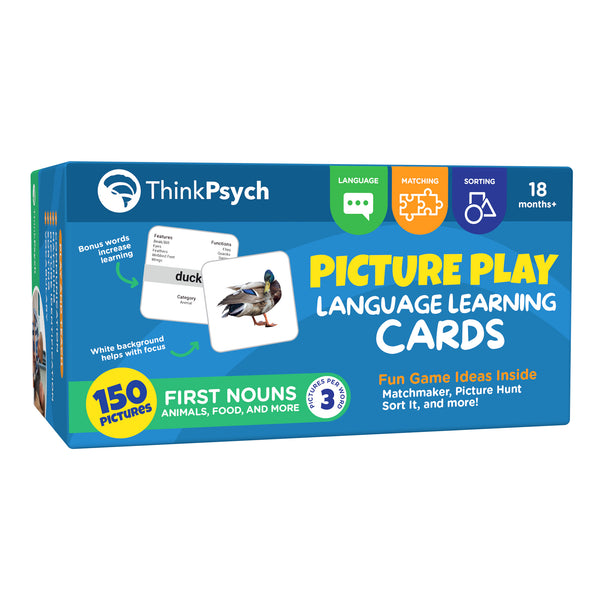
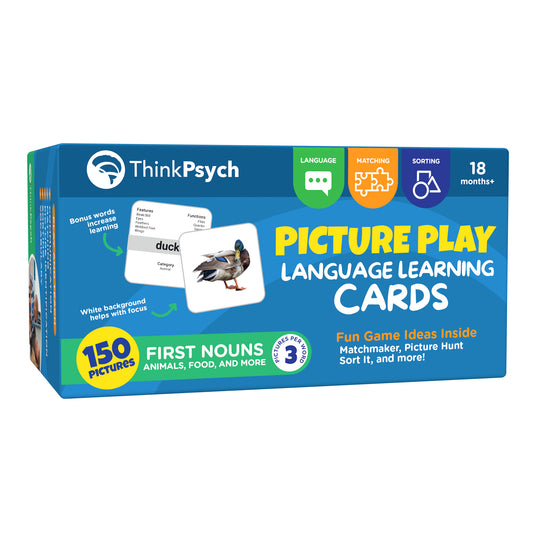
- A set of flashcards with 3 examples of 50 unique nouns (see our Language Learning Cards)
- A list of 200 common nouns or verbs that could be used to assess vocabulary (see our free list of 50 first words).
- 3-5 simple children’s books with a variety of items that could be used for labeling (e.g., First 100 Words, Curious George books)
- 25 pairs of identical items or pictures
- 25 pairs of non-identical items or pictures (e.g., pairs of items – a blue fork and a red fork – or pairs of pictures – a brown horse and a grey horse).
- 25 pairs of non-identical pictures and objects to test 2D->3D matching. For example, could include a picture of a silver fork and a blue (actual) fork.
- 10 groups of small objects that could be sorted into colors and shapes. Must contain at least 10 different colors or shapes total.
- 5 assembly toys with multiple parts (e.g., Mr. Potato Head, Little People Set, Cooties bug, Kid K’Nex, Lincoln Logs, etc.)
- List of intraverbal fill-ins and what/who/where questions.
ThinkPsych Materials Designed for VB-MAPP Assessment
To make gathering materials a little easier, we designed flashcards that line up well with milestones in levels 2 and 3. Our Language Learning Cards are 150 durable cards covering 50 words with three picture examples each, so a learner sees the same word across different exemplars rather than just one. The back of each card includes adjectives, actions, and categories for deeper work. The cards come in several sets, including First Nouns, Level 2 Nouns, and a People Set. Check them out today!
Level 3 (30 to 48 months old)
- List of 1200 words (nouns, verbs, adjectives) that could be used to track tacting (labeling) and listener responding abilities
- 4 items that can be used to teach contrasting adjectives (big, little, long, short). For example, small/large pencil and big/small ball.
- Pictures or objects that come in at least 4 colors and 4 shapes for receptive identification shapes
- 25 pairs of novel non-identical items or pictures (e.g., pairs of items – a blue fork and a red fork – or pairs of pictures – a brown horse and a grey horse).
- 20 different block designs, parquetry, or shape puzzles
- 25 pictures or objects that could be sorted into five categories (e.g., animals, clothing, furniture)
- Worksheets containing at least 20 three-step patterns, sequences, or seriation tasks
- Materials for arts and crafts task (e.g., crayons, markers, papers, scissors, finger paints)
- Materials/toys for pretend play
- Pre-academic books (e.g., dot-to-dot, matching games, mazes, tracing letters/numbers)
- Letter, number, and word flash cards
- 3-5 Books that can be used for reading and listener feature-function-class (LRFFC) identification tasks
- List of 1000 listener feature-function-class (LRFFC) identification targets
- List of 300 intraverbal questions
- List of 4 different rotating WH questions about 10 topics
- 10 small objects for demonstrating counting
Next Steps
Once you have acquired the materials you need, the next step is to get familiar with the terminology the protocol uses. We cover that next.
Next: Part 2, Terminology




1 comment
You are a generous team.