
VB-MAPP - The Complete Guide
The VB-MAPP, short for the Verbal Behavior Milestones Assessment and Placement Program, is a criterion-referenced assessment of language and learning skills in children with autism and other developmental differences. It was developed by Mark L. Sundberg, PhD, BCBA-D, and it draws on two things at once: B. F. Skinner's analysis of verbal behavior, which sorts language by what it does rather than what it looks like, and typical developmental milestones, which give the whole thing a yardstick.
In practice it is five components that work together: three assessments you administer and score, and two reference sections that tell you what to do with the scores. The Milestones Assessment measures what a learner can currently do across 170 milestones and 16 skill areas, grouped into three developmental levels. The Barriers Assessment looks at what is getting in the way. The Transition Assessment asks whether a less restrictive placement is realistic. Those three are the ones you score. The other two carry no scores of their own: Task Analysis and Supporting Skills breaks the domains down into the component skills behind each milestone, and Placement and IEP Goals turns the results into a teaching plan. Most people meet the VB-MAPP through the Milestones Assessment and discover the rest later.
This page will give you a broad overview of the VB-MAPP. We have also written an eight-part series that goes more in-depth on each of the topics covered here. If you are looking for help with a specific part of the assessment, see the table of contents.
What the Milestones Assessment measures
The Milestones Assessment is the part most people mean when they say they are running a VB-MAPP. It covers 170 milestones spread across 16 skill areas and three developmental levels, and the levels line up loosely with typical development: Level 1 around 0 to 18 months, Level 2 around 18 to 30 months, Level 3 around 30 to 48 months.
The skill areas include mand, tact, echoic, listener responding, motor imitation, independent play, social behavior and social play, visual perceptual skills and matching to sample, intraverbal, linguistic structure, classroom routines and group skills, and early academics. What makes the layout useful is that it separates skills that often get lumped together. A learner who labels fifty objects on sight but rarely asks for anything has a very different profile from one who asks constantly but labels little, even though a vocabulary count would put them in the same place.
The language of the assessment
The VB-MAPP scoring forms assume you already speak Skinner's vocabulary, which is the first hurdle for most people. A mand is a request, a tact is a label, an intraverbal is a response to someone else's words with no object present, and listener responding is following what someone says. Then come the initialisms: LRFFC for listener responding by feature, function and class, and VP/MTS for visual perceptual skills and matching to sample.
It is worth getting these straight before you score anything, because the distinctions are the whole point of the instrument. Part 2 of our eight-part series works through the terminology one operant at a time, and if you want more depth on a single one, we have a longer piece on what tacting is in ABA.
Working through the three levels
Administration is a mix of direct testing, structured observation, and asking people who know the learner well. Not every milestone needs to be tested: many can be scored from observation if you have watched enough, which tends to make the assessment shorter and the results more representative of what the learner actually does.
Our level guides follow that order. Part 3 covers Level 1, where the emphasis falls on early mands, echoics, and the foundations of listener responding. Part 4 covers Level 2 and sorts milestones into those you can observe and those that need direct testing. Part 5 covers Level 3, where reading, writing and math come in.
How the VB-MAPP is scored
Each component is scored on its own scale, which is why "how do you score the VB-MAPP" rarely has a single answer.
For the Milestones Assessment, each milestone has written criteria in the VB-MAPP Guide, and you score against those criteria rather than against your impression. Scores are plotted on the Master Scoring Form, a grid that fills in from the bottom up as skills come in, so a learner's profile is visible at a glance and the same form can be re-scored at later test dates in a different color to show progress over time. The full assessment runs to a possible 170 points across the three levels.
The Barriers Assessment uses a 0 to 4 scale on each of its 24 barriers, where 0 is no problem, 1 occasional, 2 moderate, 3 persistent, and 4 severe, for a maximum of 96. Higher is worse here, which catches people out, since it runs in the opposite direction to the milestones. The Transition Assessment covers 18 areas, with ratings on a five-point scale, and there a higher score again points toward readiness.
When progress stalls: the Barriers Assessment
The Barriers Assessment exists for a familiar situation, which is a learner whose program looks right on paper and is not moving. Rather than adding more teaching targets, it asks what is getting in the way across 24 areas, including instructional control, prompt dependency, scrolling, defective verbal operants, failure to generalize, and sensory issues.
The value of scoring it formally is that it turns a vague sense that something is off into a quantifiable number, and helps you to measure progress towards reducing the barriers. Part 6 of the series describes the Barriers Assessment in more detail.
Deciding whether a placement should change
The Transition Assessment helps to determine whether a child is ready for a less restrictive setting. It pulls together milestones scores with ratings of independence, group learning, classroom routines, social behavior, generalization, and rate of acquisition, across 18 areas.
It is a useful counterweight to two opposite instincts: moving a learner because their vocabulary has grown, and keeping a learner where they are because a move feels risky. A score on 18 dimensions makes the conversation concrete, and it gives a team something specific to work on if the child is not yet ready to transition. Part 7 of the series covers the scoring and how to use it in a team meeting.
Turning results into IEP goals
An assessment that stops at a profile has not finished its job. The VB-MAPP includes placement recommendations tied to the milestones, which give you a starting point, and the last step is writing goals a team can use to measure progress in school, clinic, or home settings.
A common pitfall is writing a goal that restates a milestone rather than describing what the learner will do, in what conditions, to what criterion. It also pays to check that a goal is worth the teaching time at all, which we cover in developing socially significant goals. Part 8 of the series goes through the drafting process, and if you are a parent looking for help on how to advocate for your child, how to get an IEP for your child covers the process itself.
Materials for administering the VB-MAPP
Beyond the VB-MAPP Guide and protocol, most of what you need is ordinary early-learner material: preferred items for mand trials, familiar objects and pictures for tacts and listener responding, and matching materials for the VP/MTS milestones. Gathering it is one of the more time-consuming parts of the job, so Part 1 of the series lists everything level by level.
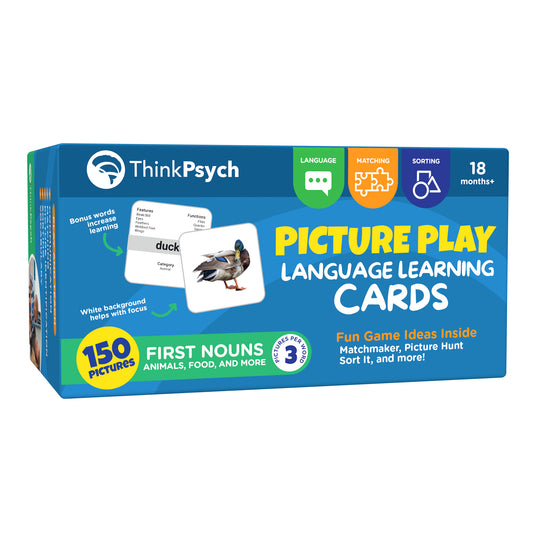
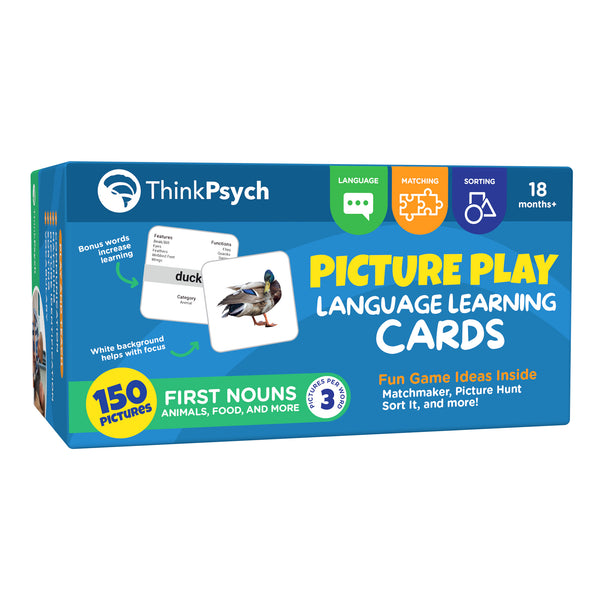
Where a commercial product really helps is in the picture stimuli, since several milestones ask a learner to respond to the same word across different exemplars. Our Language Learning Cards are built for that: 150 cards covering 50 words with three picture examples each. These durable cards are aligned with the milestones and designed for use with the VB-MAPP. The backs carry feature-function-class words to help you assess and teach this set of skills. Our free 50 first words tracker is a great tool to help record progress in language development.




Dive deeper into the VB-MAPP with our eight-part series
Each part below takes one piece of the assessment and works through it in more detail, including the scoring details this page only summarizes. You can read it from start to finish, or click over to the part that you are looking for help with right now.
| Guide | What it covers |
|---|---|
| Part 1: Materials Checklist | Everything you need to gather, listed level by level |
| Part 2: Terminology | Mands, tacts, intraverbals, listener responding, LRFFC, VP/MTS |
| Part 3: Level 1 Milestones | Administering the earliest milestones, from 0 to 18 months |
| Part 4: Level 2 Milestones | Milestones for ages 18 to 30 months, and what to observe versus test directly |
| Part 5: Level 3 Milestones | Milestones for ages 30 to 48 months, where reading, writing and math come in |
| Part 6: Barriers Assessment | Scoring the 24 barriers and what each score means |
| Part 7: Transition Assessment | Scoring readiness for a less restrictive setting |
| Part 8: Creating IEP Goals | Turning assessment results into written goals |
If you are about to run your first VB-MAPP, Parts 1 and 2 are great ones to read before you open the protocol, since gathering materials and learning the vocabulary are where most of the early time goes. The rest can wait until the assessment in front of you calls for them.
Frequently asked questions
What is the VB-MAPP?
The VB-MAPP, or Verbal Behavior Milestones Assessment and Placement Program, is a criterion-referenced assessment of language and learning skills developed by Mark L. Sundberg. It combines a 170-milestone assessment across 16 skill areas and three developmental levels with a barriers assessment, a transition assessment, a task analysis section, and placement and IEP goal recommendations.
How do you score the VB-MAPP?
Each component scores differently. Milestones are scored against written criteria in the VB-MAPP Guide and plotted on the Master Scoring Form, to a possible 170 points across the three levels. The Barriers Assessment rates each of 24 barriers from 0 for no problem to 4 for severe, giving a maximum of 96, where a higher score indicates more to work on. The Transition Assessment covers 18 areas with ratings on a five-point scale.
What age range is the VB-MAPP for?
The milestones are sequenced against typical development up to about 48 months, in three levels covering roughly 0 to 18 months, 18 to 30 months, and 30 to 48 months. Because it is criterion-referenced rather than norm-referenced, it is regularly used with older learners whose language skills fall within that developmental range, and the score describes current skills rather than assigning an age.
How long does a VB-MAPP take to complete?
It varies a great deal with the learner and with how much of the assessment you are running, so a single figure would be misleading. What tends to shorten it is scoring from observation wherever the criteria allow, rather than testing every milestone directly, and gathering information from people who see the learner daily.
Who can administer the VB-MAPP?
It is generally administered by professionals familiar with verbal behavior and with the learner, most often behavior analysts, speech language pathologists, and special educators, though parents and paraprofessionals often contribute observations. Scoring it well depends less on a credential than on knowing the operant definitions well enough to apply the criteria consistently.
Sources
- Sundberg, M. L. (2008). VB-MAPP: Verbal Behavior Milestones Assessment and Placement Program. AVB Press.
- Skinner, B. F. (1957). Verbal Behavior. Appleton-Century-Crofts.