
School Counseling Games for Small Groups and Classrooms
Games are one of our favorite ways to teach social-emotional skills in school counseling! As you know, games are a great way to build rapport with guarded students and help them open up. This guide covers a selection of games specifically designed for school counseling work, and information to help you decide which one is best for your setting.
The sections are organized by what you are working on rather than by product category. Each one covers the skill, the games that fit it, and the specifics worth checking before you buy: the age range, how many students can play, and how much reading the game asks for.
Most of these work in a small group as readily as they do one to one, and the table below gives the player range for each. If you are also planning whole-class lessons, our guide to incorporating social emotional learning in the classroom covers that side.
Quick comparison
| Game | Best for | Ages | Players |
|---|---|---|---|
| Feelings Bingo | Emotion words in a lunch-bunch or small group | 5+ | 2–6 |
| Go Fish: Faces & Feelings | Identifying and expressing emotions | 6+ | 2–6 |
| Emotion Town Puzzle Pack | A quiet emotion-focused opener with younger students | 4+ | 1+ |
| Roll With It Coping Skills Kit | Practicing a coping strategy before it is needed | 5+ | 1+ |
| Escape from Anger Mountain | Anger and frustration tolerance | 6+ | 2–6 |
| Chat Chains | Friendship and conversation groups | 8+ | 2+ |
| Dive In | Groups with a wide age range & icebreakers | 5+ | 2+ |
| Talent Jam | Confidence and speaking up | 8+ | 3–6 |
| The Exposure Deck: Social Anxiety Edition | Structured practice with anxious high schoolers | 13+ | 1+ |
When you are teaching students to name what they feel
Emotion vocabulary is often where this work starts, since telling frustrated apart from embarrassed makes it easier to choose a strategy for either one. We go into the case for starting here in why teaching children to identify emotions is important.
One thing worth checking before you buy is how much reading a game requires. A feelings activity built on word lists can turn into a reading task for a student who is not yet reading fluently, which won't be fun or educational.
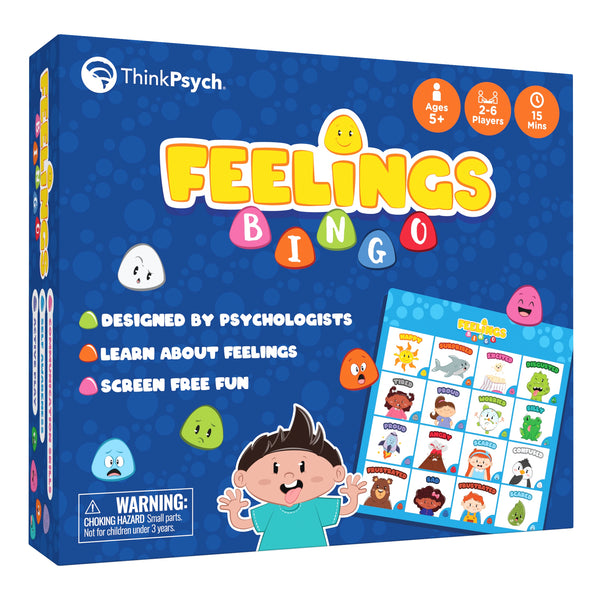
Feelings Bingo (ages 5+, 2 to 6 players) is our usual pick for a small group. Students draw cards and act out emotions to find matches. No reading is needed, and the deck has beautiful art with human emotions, animal characters, and expressive objects, which keeps a six-round game from feeling repetitive. The box comes with 12 bingo cards, 39 emotion cards, 96 chips, 4 challenge cards, and a storage bag, so it travels as one piece.
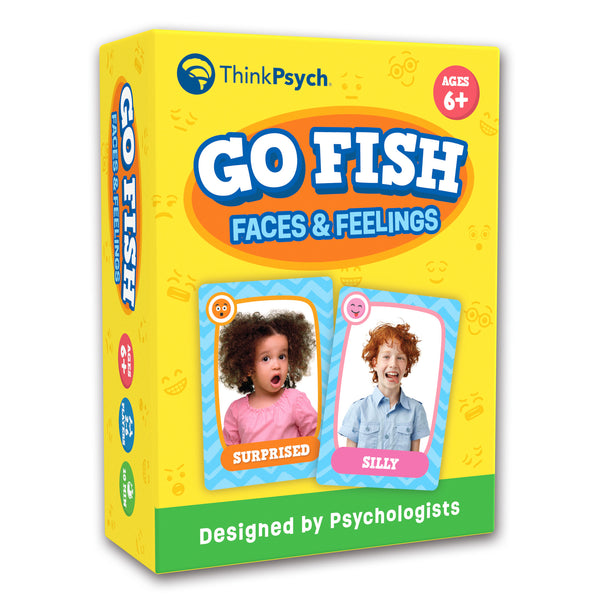
Go Fish: Faces & Feelings (ages 6+, 2 to 6 players) is great for both one-on-one counseling and small groups. Students act out feelings to collect cards rather than asking for them by name, and the same 56-card deck plays as either Go Fish or Memory Match, which gives you two ways to play from one box. Rounds are short, so it is easy to stop at a natural point.
Emotion Town Puzzle Pack (ages 4+) is a great option for younger kids in Elementary. Four 60-piece scenes, one each for Happy, Sad, Scary, and Angry Town, give a younger student something to do with their hands while the conversation about feelings happens alongside the activity rather than head on. Some students find that easier than talking across a table.
When you are working on anger and frustration
Naming feelings usually comes first, and regulation is often the next piece. One difficulty with coping-skills work is that it can stay abstract: being able to list strategies is not quite the same as having one ready in the moment, and the two may need different kinds of practice.
Escape from Anger Mountain (ages 6+, 2 to 6 players, about 20 minutes) is built for exactly that gap. Players roll and move down the mountain using real coping strategies drawn from a set of 125 cards covering coping skills, affirmations, sharing prompts, and movement activities. The board game format is doing something specific: it produces a bit of genuine frustration in the room, safely and with an adult present, which may be a better place to practice tolerating it than a worksheet. We have more on the topic in anger management tips for kids.
Roll With It Coping Skills Kit (ages 5+) is the one to reach for when the goal is building a comprehensive coping toolbox. It is a nine-piece kit built around coping dice, with a feelings identification card, a sensory mat, a stress ball, and a guide covering more than 50 coping strategies. The dice do something a printed strategy list does not: they take away the choice paralysis of deciding what to try, and rolling to pick a strategy makes the practice feel like a game rather than an assignment. Once a student knows it, the kit can also work as a tool they use on their own.
When you are running friendship and conversation groups
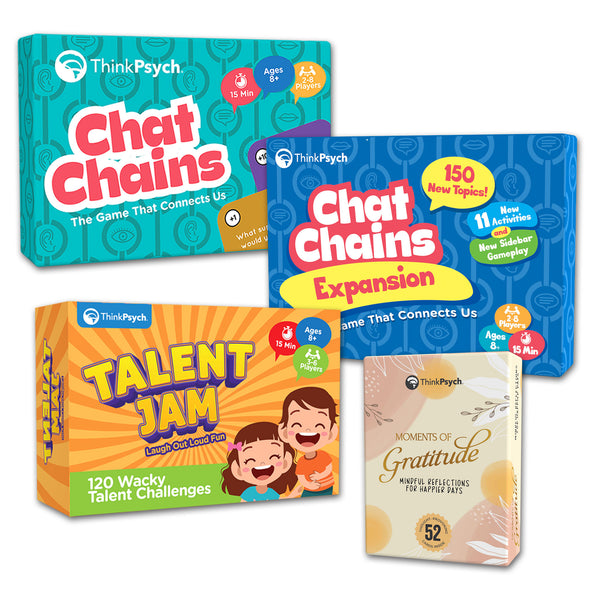
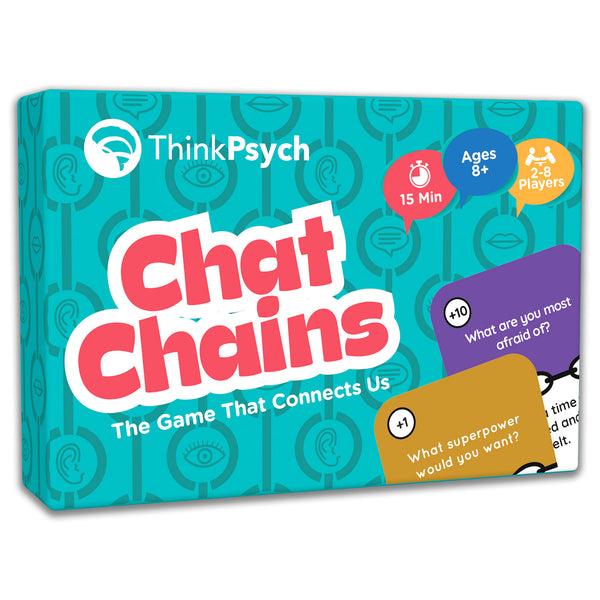
Chat Chains (ages 8+) helps students see the building blocks of a conversation rather than just being told to have one. You start with a topic card, then add question and answer cards to build the conversation chain, which makes the invisible structure of a back-and-forth something a student can point at. There are 150 topics in the base game, designed to run in roughly 15 minutes, and an expansion pack with 150 more. Of everything here, this is the one that covers the widest span of ages and ability levels.
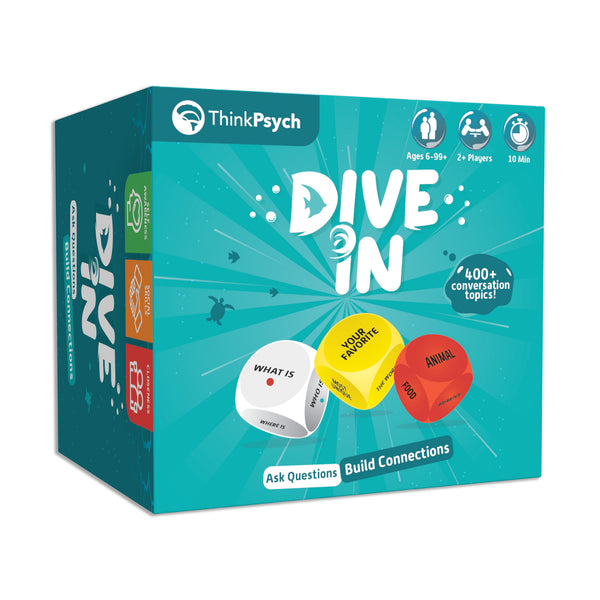
Dive In (ages 5+) uses dice to build the question and cards to go deeper, with more than 400 topics ranging from funny icebreakers to genuinely thoughtful ones. Its real strength in a school is the mixed group, since each card carries two levels of depth. That suits a peer mentoring pair across grades or any group where the students are not all at the same place socially.
Being quiet and lacking the skill are not the same thing, and they may call for different pacing. Our notes on building social skills in shy kids go into that difference.
When a student needs practice being seen
Talent Jam (ages 8+, 3 to 6 players) targets something narrower than conversation: the willingness to be looked at. There are 120 performance challenges across drawing, singing, acting, and movement in four color-coded categories, with one performer and multiple voters each round so nobody is sitting idle waiting for a turn. Which leads to lots of laughs!
This one may land better once a group has some rapport, and it can be a useful bridge for a student who is ready to do more than talk about confidence.
When you are working with older students on social anxiety
The Exposure Deck: Social Anxiety Edition (13+) is the outlier here, because it is a counseling tool rather than a game. It holds 150 ready-made exposure challenges spanning conversations, public speaking, assertiveness, errands, and social media, and ships with a therapist guide, a client quick-start guide, and a reference card. It was designed by Lauren J. Hoffman, PsyD, using exposure therapy principles.
The practical value is that it removes the blank-page problem. Building a fear ladder from scratch can take up a good deal of session time, and a ladder built on the spot can end up with large jumps in it. Working from a fixed set of challenges makes the pacing conversation more concrete, and it gives you something specific to assign between sessions.
Worth saying plainly: exposure work sits at the clinical end of what school counseling covers, and whether it belongs in your role depends on your scope of practice and your district. Some counselors use the deck as a discussion starter and a referral aid instead.
Not sure where to start?
If you are putting together a kit rather than filling a single gap, the grade-band toolkits group these by age. The Elementary School SEL Toolkit pairs the bilingual poster set with Dive In, Find & Match: Feelings Safari, Go Fish: Faces & Feelings, and Roll With It. The Middle School SEL Toolkit swaps in Chat Chains with its expansion and Talent Jam for older students, and there is a High School & Teen Engagement Toolkit for grades nine and up.
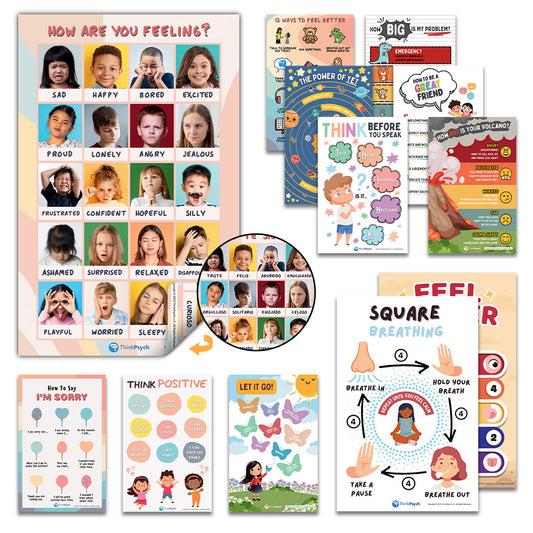
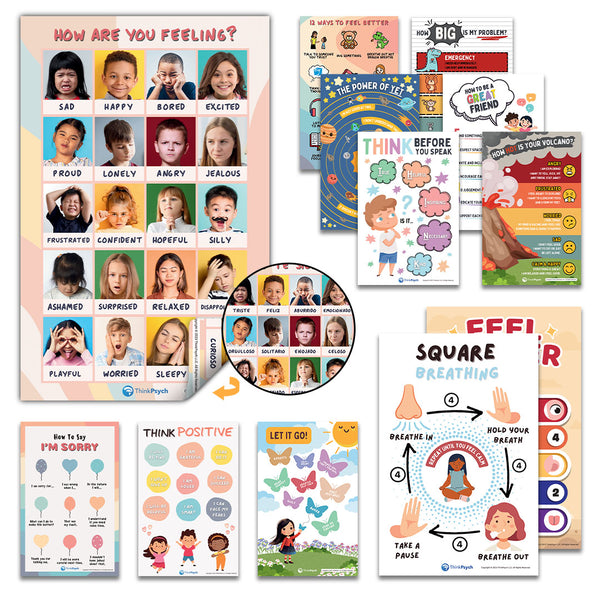
For the office itself, the Feelings & Coping Skills Posters come in English and Spanish sides covering 20 emotions and 12 coping strategies, laminated to take a dry erase marker, so they can be written on and wiped clean. The full emotions and coping skills collection, the social skills games collection, and the SEL bundles and therapy toolkits are the places to browse from there. If your work leans clinical rather than school-based, our roundup of the best therapy games for kids covers the same catalog from that angle.
Frequently asked questions
What games work best for small group counseling?
It depends on the skill. For emotion vocabulary with younger students, Feelings Bingo suits 2 to 6 players and needs no reading. For anger and frustration work, Escape from Anger Mountain takes 2 to 6 players and runs about 30 minutes. For friendship and conversation groups, Chat Chains works across a wide range of ages and ability levels.
Which counseling games fit a short session?
Go Fish: Faces & Feelings and Feelings Bingo both play in short rounds that stop at a natural point. Chat Chains is designed around roughly 15 minutes. Escape from Anger Mountain runs closer to 30 minutes with larger groups, so it suits a longer block of time.
Which games work for students who cannot read yet?
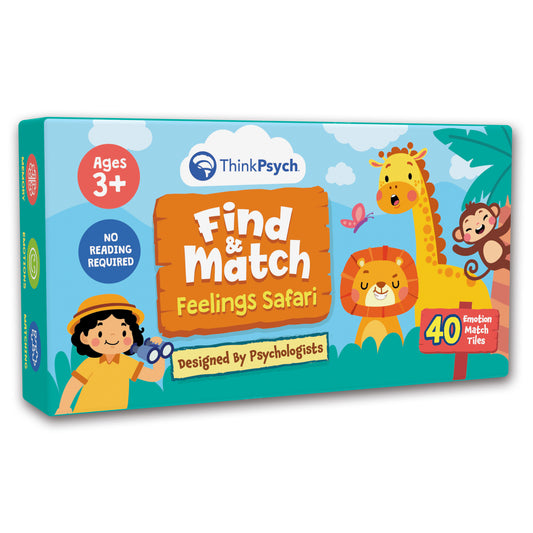
Feelings Bingo and Go Fish: Faces & Feelings are both designed to be played without reading, since students act out or match images rather than reading prompts. Find & Match: Feelings Safari uses illustrations for the same reason. The Emotion Town puzzles need no reading at all.
Is there evidence behind SEL games in schools?
The evidence supports the approach rather than any particular box. Durlak and colleagues' meta-analysis of 213 school-based SEL programs found improvements in social and emotional skills, attitudes, behavior, and academic performance. Individual commercial games are generally not trialed themselves, so it is fair to say the method has support.
Can school counseling games be used in a classroom lesson?
Several adapt reasonably well. Feelings Bingo scales to a class if you run it from the front with students acting out draws, and the poster set is great for classroom walls. Games with a fixed player count, such as Talent Jam at 3 to 6, are better kept for small groups or run as a station rotation.
Sources
- Durlak, J. A., Weissberg, R. P., Dymnicki, A. B., Taylor, R. D., & Schellinger, K. B. (2011). The impact of enhancing students' social and emotional learning: A meta-analysis of school-based universal interventions. Child Development, 82(1), 405–432.