
Feelings Games for Kids by Age and Stage
A feelings game is any game that builds learning about emotions directly into how it is played. That might mean matching two faces that show the same feeling, acting out what frustrated looks like, or drawing a card that asks you to use real coping strategies. What they have in common is not one mechanic. It is that the emotional part is woven seamlessly into the gameplay mechanics.
At ThinkPsych, we make feelings games because we believe emotional intelligence is critical for a happy life. Our games are designed by psychologists to help make learning about emotions both accessible and fun. We ask a simple question: would we want to play this game with our kids? If the answer is yes, we're on the right track!
Which one suits your child is mostly a question of what they can already do. This guide is organized by age and stage, with the details worth knowing before you buy.
Quick comparison
| Game | Best for | Ages | Players |
|---|---|---|---|
| Find & Match: Feelings Safari | First emotion words, before reading | 3+ | 1–4 |
| Feelings Clock Puzzle | Use the puzzle to talk about emotions, daily | 3+ | 1 |
| Emotion Town Puzzle Pack | Explore an emotional scene while you puzzle together | 4+ | 1+ |
| Feelings Bingo | Family game night with mixed ages | 5+ | 2–6 |
| Go Fish: Faces & Feelings | Familiar gameplay, silly face imitation | 6+ | 2–6 |
| Escape from Anger Mountain | Anger and frustration tolerance | 6+ | 2–6 |
| Roll With It Coping Skills Kit | Building a coping skills toolbox | 5+ | 1+ |
| Dive In | Dinner table talk across a wide age gap | 5+ | 2+ |
For kids who don't read yet
Before a child can tell you they are frustrated, they need the word, and the word is only useful once it is attached to something they can see. This takes longer than it sounds. A two year old who can say "happy" may still sort every strong feeling into happy or bad, and the middle of the range arrives gradually over the next few years. Our post on why teaching children to identify emotions is important covers this phase of development.
The thing worth checking at this age is whether an activity requires reading. A feelings game built on word lists becomes a reading task, which is not what you were after.
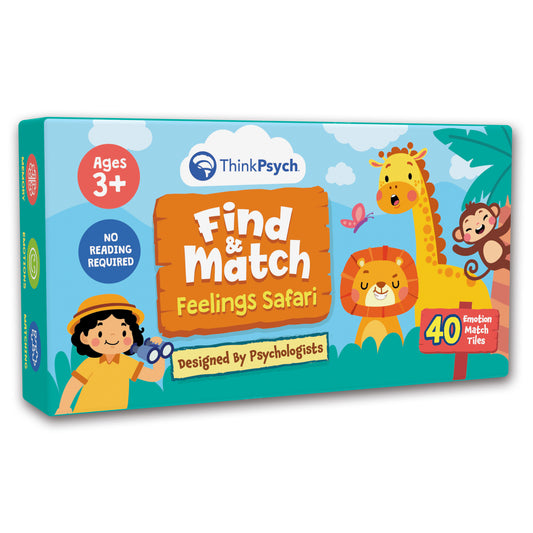
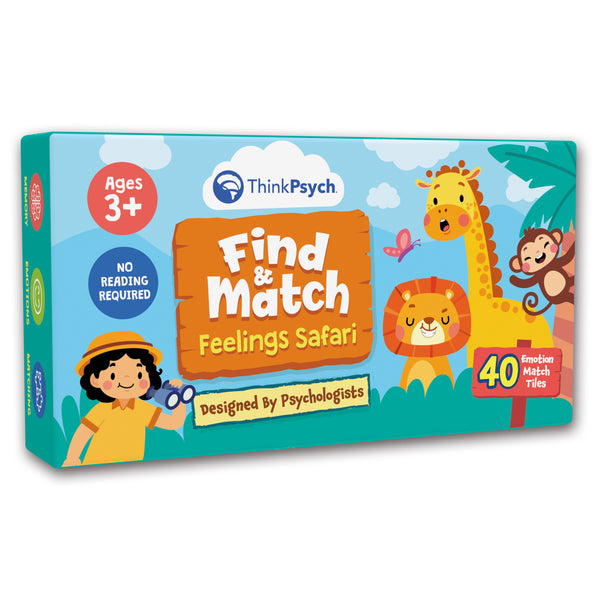
Find & Match: Feelings Safari (ages 3+, 1 to 4 players) covers 10 emotions across 40 thick laminated tiles, using expressive animals and children. There are two ways to play, matching faces or matching images, plus bonus games, and no reading is needed. Matching is a forgiving format at this age: a wrong guess just means turning the tile back over, so the temperature of the game stays low. Best of all, a child can play it alone as happily as with you. If matching games are landing well generally, we have more on why in the best matching games for kids.
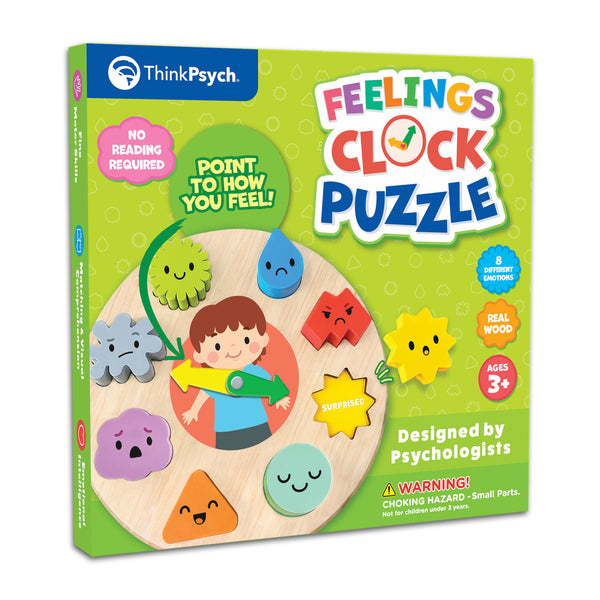
Feelings Clock Puzzle (ages 3+) is great for daily emotional check-ins. It is a wooden puzzle with movable clock hands that point to eight emotion pieces, which makes an abstract thing physical: a child who cannot yet explain a feeling can still move a hand to it, and that is a much smaller ask. It works well as a conversation starter folded into a routine you already have, such as breakfast or bedtime.
Emotion Town Puzzle Pack (ages 4+) takes a different route. Four 60-piece scenes, one each for Happy, Sad, Scary, and Angry Town, come with a picture reference card and a solid wooden board. In the included Instructions Guide, we suggest conversation starters you can use with your kids to explore each puzzle and talk about the emotions featured in each scene.
Familiar gameplay, emotional learning built-in
Both games in this section borrow a format your child already knows. There are no new rules to learn, so you can deal the cards and start, and both run in short rounds that you can even play on a school night.
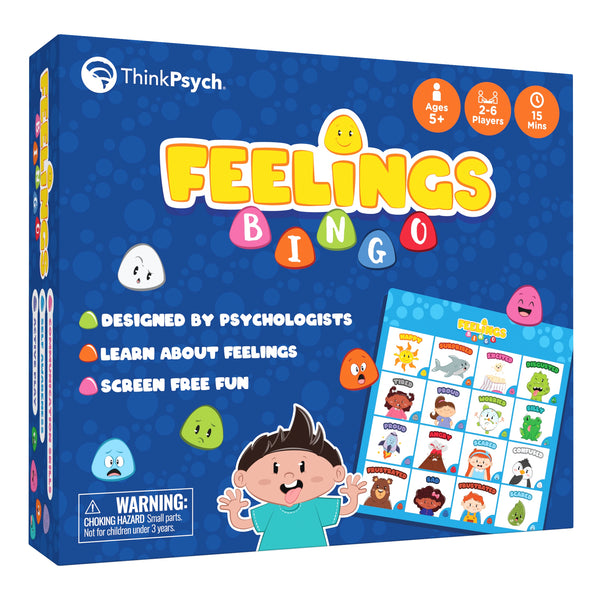
Feelings Bingo (ages 5+, 2 to 6 players) is a lot of fun to play with a group. Players act out an emotion to mark their cards, so no reading is needed, and the deck runs through human emotions, animal characters, and expressive objects rather than the same six faces over and over. The game comes with 12 bingo cards, 39 emotion cards, 96 chips, 4 challenge cards, and a storage bag to make it a great travel game.
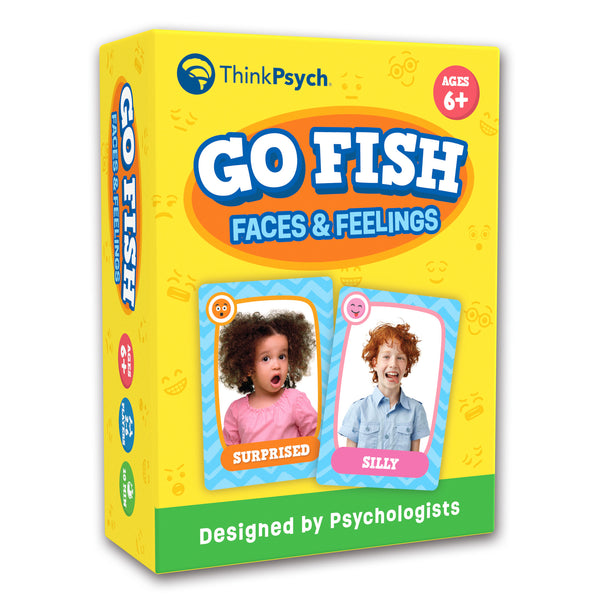
Go Fish: Faces & Feelings (ages 6+, 2 to 6 players) asks children to act out feelings to search for matches to cards in their hands. Thanks to visual cues, no reading is required. Just like ordinary Go Fish, the player with the most pairs at the end is the winner. The same 56-card deck also can be used for a Memory Match game. Familiar, fun gameplay that's quick to pick up and hard to put down!
When anger bubbles up
Anger is loud, which is part of why it gets everyone's attention. Naming it is a good start, and having something ready to do is the other half. That half is harder to practice, since doing coping skills when you're angry is really tough. This is where a game earns its place: a bit of real frustration, at a table, with everyone calm enough to work through it. For more support with this topic, see our anger management tips for kids.
Escape from Anger Mountain (ages 6+, 2 to 6 players) is built around exactly that gap. Players roll and move down the mountain using real coping strategies drawn from 125 cards covering coping skills, affirmations, sharing prompts, and movement activities. The board game format may be doing something a worksheet cannot: a game produces a small and genuine amount of frustration, with an adult in the room and very little at stake, which is arguably a good place to practice tolerating it. The player count also means the whole family can be in it together rather than working one-on-one with your child.
Roll With It Coping Skills Kit (ages 5+) is a nine-piece kit built around coping dice, with a feelings card, a sensory mat, a tablet, a stress ball, and a guide covering more than 50 research-backed coping skills. The dice may help with something a printed list cannot, which is that choosing feels like work when you are already upset. Rolling takes the choosing away and turns the practice into something that feels like a game. Once you have taught it, many families leave it out as a calm-down station a child can go to on their own.
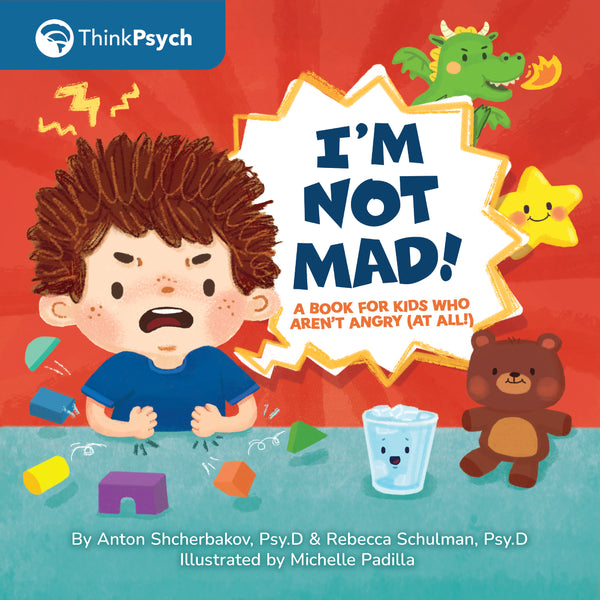
I'm Not Mad! is our book focused on helping kids develop anger management skills. Written by psychologists, it follows Sam working out what anger actually feels like in the body, the racing heart and hot face and tense muscles, and then practicing real coping strategies. It can be read as a bedtime book or as part of a lesson, and it leaves you both with shared words to use later.
When they are older, and you want to help them open up
With older kids (teens especially), sometimes the most difficult thing is having them tell you anything at all. That's why we also make games to help kids and parents have real conversations.
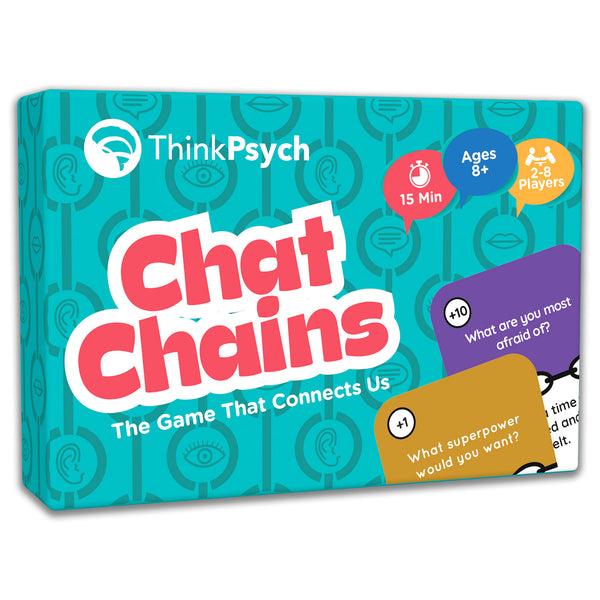
Dive In (ages 5+) holds more than 450 conversation topics, mixing light icebreakers with genuinely thoughtful ones. You roll dice to build the question, then use card prompts to go even further. Each card carries two levels of depth, which is what makes it usable when a nine year old and a fifteen year old are at the same table and neither wants to play something pitched at the other. It is built for family conversation rather than emotion vocabulary. If getting started is the harder part, breaking the ice with an untalkative teen goes into that.
Building your collection of feelings games
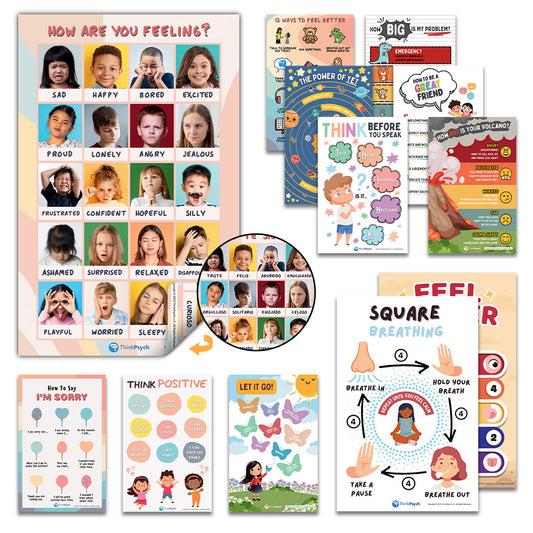
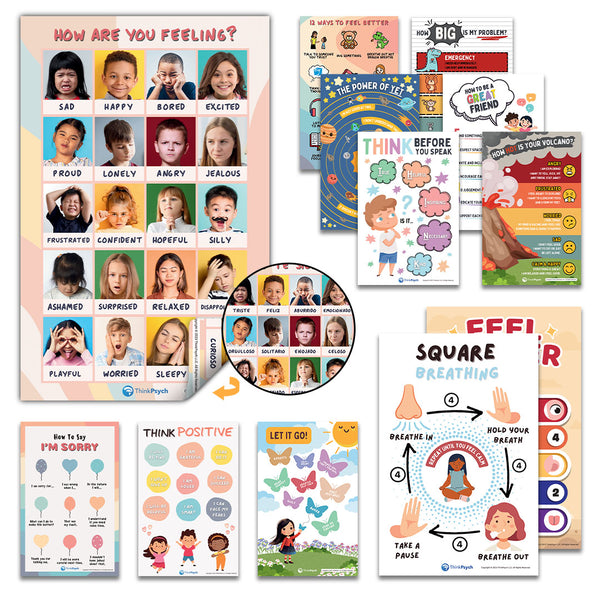
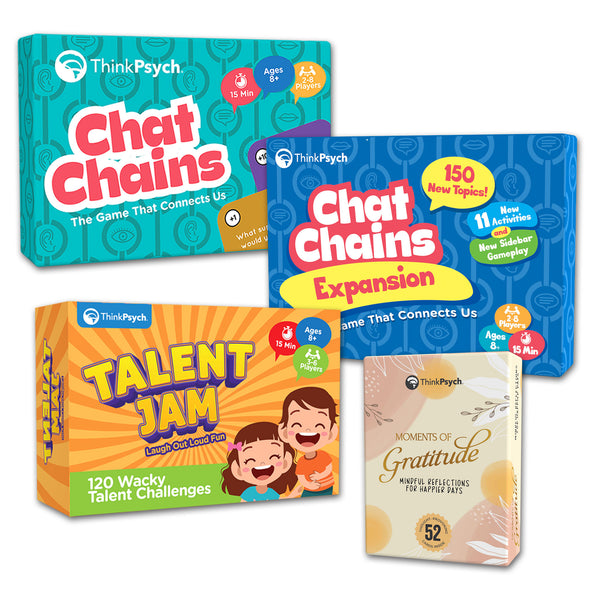
If you would rather start with a set than pick one thing, the Emotional Regulation Skills Complete Collection pairs Find & Match: Feelings Safari and Go Fish: Faces & Feelings with Roll With It and the 12-pack of bilingual SEL posters. The Elementary School SEL Toolkit covers similar ground and adds Dive In, which suits a household with a wider age range. From there, the emotional awareness and coping skills collection and the family games collection are the places to browse.
Frequently asked questions
What are the best feelings games for kids?
It depends on where your child is. For pre-readers, Find & Match: Feelings Safari suits ages 3 and up and needs no reading. For family game night, Feelings Bingo works for ages 5 and up with 2 to 6 players. For anger specifically, Escape from Anger Mountain is built around practicing coping strategies while a little real frustration is in the room.
Which feelings games work for children who cannot read yet?
Feelings Bingo and Go Fish: Faces & Feelings are both designed to be played without reading, since children act out emotions rather than reading prompts. Find & Match: Feelings Safari uses illustrations for the same reason, and the Feelings Clock Puzzle and Emotion Town puzzles need no reading at all.
At what age should children start learning about emotions?
Emotion vocabulary generally builds gradually from the toddler years onward, so there is rarely one starting point. In practice the more useful question is what format your child can manage. Puzzles and matching tiles ask very little and suit younger children, while games with turns and rules tend to land better once a child is comfortable losing a round.
Do feelings games actually help?
The evidence supports the general approach rather than any particular game. Denham and colleagues found that preschoolers' emotion knowledge predicted later social competence, and Durlak and colleagues' review of 213 school-based social and emotional learning programs found gains in social skills, behavior, and academic performance. Individual commercial games are usually not trialed on their own, so it is fair to say the overall method has support.
How do I get an older child to play one without the eye-rolling?
Usually by not calling it a feelings game. Something built for family conversation rather than emotion instruction, such as Dive In, tends to go down better because it's genuinely fun and engaging for all ages. It also helps a great deal if the adults play properly and answer the questions themselves rather than supervising.
Sources
- Denham, S. A., Blair, K. A., DeMulder, E., Levitas, J., Sawyer, K., Auerbach-Major, S., & Queenan, P. (2003). Preschool emotional competence: Pathway to social competence? Child Development, 74(1), 238–256.
- Durlak, J. A., Weissberg, R. P., Dymnicki, A. B., Taylor, R. D., & Schellinger, K. B. (2011). The impact of enhancing students' social and emotional learning: A meta-analysis of school-based universal interventions. Child Development, 82(1), 405–432.