
Feature Function Class Examples and a Free LRFFC Data Sheet
LRFFC stands for Listener Responding by Feature, Function, and Class. It is a more advanced kind of listener responding, where a learner picks out an object after hearing a description of it rather than hearing its name. Instead of "touch the dog," the instruction becomes "touch the one that has fur," "touch the one you walk on a leash," or "touch an animal."
This page covers what feature, function, and class each mean, gives examples of all three that you can take straight into a session, and includes two free feature function class data sheets you can download and use to track what a learner already knows.
What does LRFFC stand for in ABA?
LRFFC is short for Listener Responding by Feature, Function, and Class. It comes from B. F. Skinner's analysis of language, which is also the framework behind the VB-MAPP, and we unpack the rest of that vocabulary in our guide to VB-MAPP terminology.
Plain listener responding means following a direction or identifying something by name. A teacher says "touch your nose" and the child touches their nose. LRFFC asks for more than that. The child hears an associated characteristic rather than the label, and has to work out which item in front of them fits it.
That step matters because it is the point where a child starts to understand objects as things with properties and categories, not just as names. It also opens the door to adjectives, verbs, and categories more generally. This skill often begins to emerge somewhere around two to three years of age, though the range in practice is wide.
Feature, function, and class: what each one means
The three parts of LRFFC are easy to mix up, and a lot of teaching targets get written under the wrong one. Here is the distinction we find easiest to hold on to.
Feature is a part of the object, or something you can see about it. Wheels, ears, wings, a handle, a zipper, a lid. If you could point at it on the object itself, it is probably a feature.
- "Touch the one that has wheels" (car, bike, wagon)
- "Find something with wings" (bird, plane, butterfly)
- "Show me the one with buttons" (shirt, remote, microwave)
- "Which one has a tail?" (dog, cat, horse)
- "Find the one with laces" (shoe, boot, sneaker)
Function is what the object does, or what you do with it. Function targets usually contain a verb, which is a quick way to check whether you have written one.
- "Touch something you eat" (apple, sandwich, cookie)
- "Find the one you sleep in" (bed, crib, sleeping bag)
- "Show me something you write with" (pencil, pen, crayon)
- "Which one do you wear on your feet?" (shoe, sock, boot)
- "Find something you drink" (milk, juice, water)
Class is the category the object belongs to. Class targets are usually a single noun that covers a group, and they tend to be the hardest of the three, since the category itself is not something a child can see.
- "Touch an animal" (dog, cow, fish)
- "Find a vehicle" (car, bus, train)
- "Show me a piece of furniture" (chair, table, couch)
- "Which one is a fruit?" (banana, grape, orange)
- "Find something that is clothing" (shirt, hat, pants)
A list of classes worth teaching
When you are building out class targets, it helps to have a list in front of you rather than inventing categories one at a time. These are the ones that come up most often in early language programs, roughly in the order they tend to be introduced:
- Animals, food, drinks, clothing, toys
- Vehicles, furniture, body parts, shapes, colors
- Fruits, vegetables, kitchen items, bathroom items, school supplies
- Tools, musical instruments, sports equipment, insects, places
A useful check on any class target is whether the category holds up with three or four clearly different examples. If a child only ever sees the same picture of a dog under "animal," the category may not be doing much work yet. Our post on generalization in ABA covers why that matters.
Download our free feature function class data sheets


Both are spreadsheets, so you can print them or keep them open on a tablet during a session. The First Nouns sheet covers early vocabulary, and the Advanced Nouns sheet picks up where it leaves off.
How to use the feature function class list

The data sheet is divided into eight columns: two for features, one for functions, and one for class. Pick a feature or function you want to check, then set up a small array. Say you have chosen the feature "pillows." Show your learner a picture of a bed, a dog, and a car, and ask them to touch the one that has pillows. If they select the bed, write today's date in that box and treat it as mastered. Work through the sheet this way and you end up with a map of what the learner already has and what is worth teaching next.
Two things that tend to help. Keep the array to three items early on and grow it later, and vary which position the target sits in, since some learners will happily learn "it is the one on the left" instead of the actual skill. If you want a fuller picture of how prompting fits around this, our guide to prompt hierarchies goes through the options.
LRFFC fill-in statements
Alongside the "touch the one that" format, many LRFFC targets are written as fill-in statements paired with a picture array. You say "you sleep in a..." while the learner is looking at a set of pictures, and they select the bed. Same skill, different wrapper, and some learners find one form noticeably easier than the other.
- "You eat a..." (apple)
- "You drive a..." (car)
- "A dog says..." (with pictures present)
- "You brush your..." (teeth)
- "You wear shoes on your..." (feet)
It is worth keeping this separate in your head from an intraverbal fill-in, where there is no array and the learner has to produce the word from the verbal statement alone. The LRFFC version keeps a visual field in play, which is usually the easier of the two and often comes first. Our explainer on tacting covers the neighbouring skill of labeling what you see.
Where LRFFC sits in the VB-MAPP
In the VB-MAPP, LRFFC is a milestone area that appears at Levels 2 and 3 rather than Level 1, which reflects that it builds on earlier listener responding and matching skills. If you are working through the assessment itself, our complete guide to the VB-MAPP covers the whole thing, and Part 4 on Level 2 is where LRFFC targets first show up on the protocol.
If you are scoring a learner and the LRFFC milestones are coming back low while listener responding and matching are solid, that gap is often a reasonable place to put teaching effort next.
Finding materials to use for LRFFC
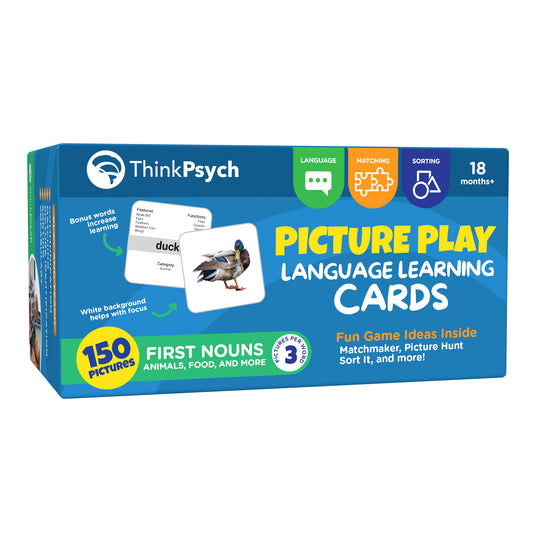
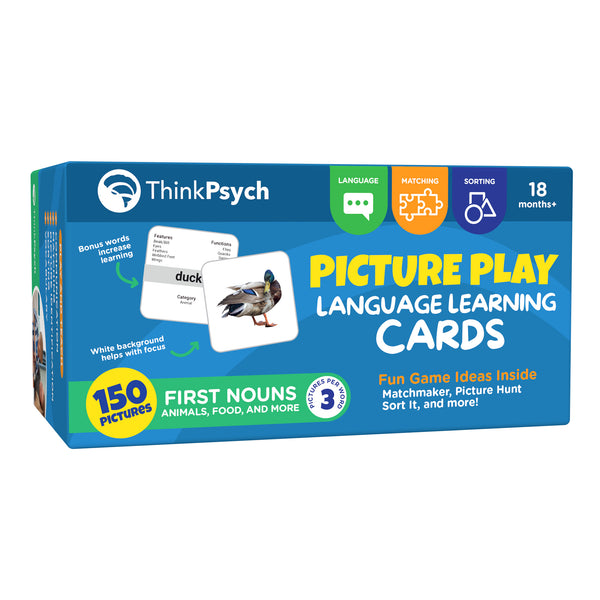
One of the harder parts of running good ABA sessions is having the right materials on hand, and LRFFC is demanding that way, since you need several pictures of several different things for every array. That is why we put together our Language Learning Cards. The First Nouns set is designed to be used with the First Nouns data sheet above, and it holds 150 cards covering 50 words with three picture examples each across animals, food, and household objects. The three examples per word are there to support generalization, so a learner is not attached to one particular picture of a cup.
Best of all, the back of each card carries the adjectives, actions, and categories for that word, so the feature, function, and class prompts are already written for you. There are also Level 2 Nouns and People sets if you need to keep going past early vocabulary.
Frequently asked questions
What does LRFFC stand for?
LRFFC stands for Listener Responding by Feature, Function, and Class. It describes a learner selecting an item after hearing one of its characteristics rather than its name, such as "touch the one that has wheels."
What is the difference between a feature, a function, and a class?
A feature is a part of the object you could point to, such as wheels or a tail. A function is what you do with it, so function prompts usually contain a verb, such as "something you eat." A class is the category it belongs to, such as animal or vehicle.
How is LRFFC different from listener responding?
Listener responding covers following directions and identifying items by name. LRFFC is a more advanced form of it, because the learner is given a description rather than the label and has to work out which item fits.
Is LRFFC the same as an intraverbal?
No. LRFFC is a listener skill, so the learner selects from items that are present. An intraverbal is a speaker skill with no visual array, where the learner produces the answer from the verbal statement alone. Fill-in statements appear in both, which is where the two are most often confused.
At what level does LRFFC appear in the VB-MAPP?
LRFFC milestones appear at Levels 2 and 3 of the VB-MAPP rather than Level 1, since the skill builds on earlier listener responding and visual matching abilities.
At what age does LRFFC usually emerge?
It often begins to appear somewhere around two to three years of age in typically developing children, which lines up with where the milestones sit in the VB-MAPP. Individual variation is considerable, so the assessment is a better guide than age alone.